
 Ultimate guide
Family Office Succession Planning and Wealth Preservation
Quick Summary
Family office succession is the advance decision of who will hold and steward a family's wealth, on what terms and under which governance rules. For UK families it combines trust law, inheritance tax planning and governance, and works best when agreed while the family is stable rather than under pressure.
- Treat succession as a governance question before it becomes a tax question.
- Start planning when the family is stable, not when a transition is imminent.
- A family constitution should cover purpose, decision rights, family roles, disputes and amendments.
- Its amendment procedure matters most, since a constitution that cannot change will be ignored.
- Stage heirs' exposure: observe committees, take bounded roles, then receive governance training.
Table of Contents
- Why Family Office Succession Planning Matters Now
- When a Family Office Should Start Succession Planning
- Building a Family Constitution Template That Holds
- Family Wealth Preservation Strategies Across Generations
- Next-Generation Wealth Transfer and Preparing Heirs
- Family Office Succession Plan Examples and What They Show
- Booking a Succession Planning Review With Integer Wealth Global
- Frequently Asked Questions
Family office succession planning is the process of deciding, well before it is needed, who will hold and steward a family's wealth, on what terms, and under which governance rules. For UK families, it sits at the intersection of trust law, inheritance tax planning and the practical challenge of keeping a multigenerational enterprise intact. The sections below set out how to approach this problem with discipline rather than improvisation.
Last Updated: 1 November 2026
Why Family Office Succession Planning Matters Now
The central risk in family wealth is rarely the market. It is the handover. Where principals change without a written plan, decision-making tends to fragment at exactly the moment continuity matters most.
Succession is therefore a governance question before it is a tax question. The structures that carry a family's capital across generations depend on clear roles, agreed decision rights and a shared understanding of purpose. Readers who want the wider framework behind this can turn to our Family Office Governance: A Complete 2026 Guide, which covers the governance architecture that succession planning rests upon.
Delay compounds the problem. Heirs who have had no exposure to the family's investment process arrive at a transfer with little context, and advisers inherit a set of decisions made informally over decades.
When a Family Office Should Start Succession Planning
Start when the family is stable, not when a transition is imminent. A plan drafted under pressure, during illness or after a death, is almost always narrower and more contested than one agreed in advance.
A practical trigger list is useful here:
- A principal reaches a stated retirement or age milestone
- A significant liquidity event changes the portfolio's structure
- A next-generation member expresses interest in a formal role
- The family adds a new branch, jurisdiction or asset class
Watch out: waiting for a single trigger event is a common error. By the time the trigger arrives, the family has usually lost the window for measured discussion.
Building a Family Constitution Template That Holds
A family constitution is the written reference point for how the family and its office will operate. It typically covers shared values, decision rights, membership criteria for family roles, dispute resolution and the conditions under which the family revisits its own rules.
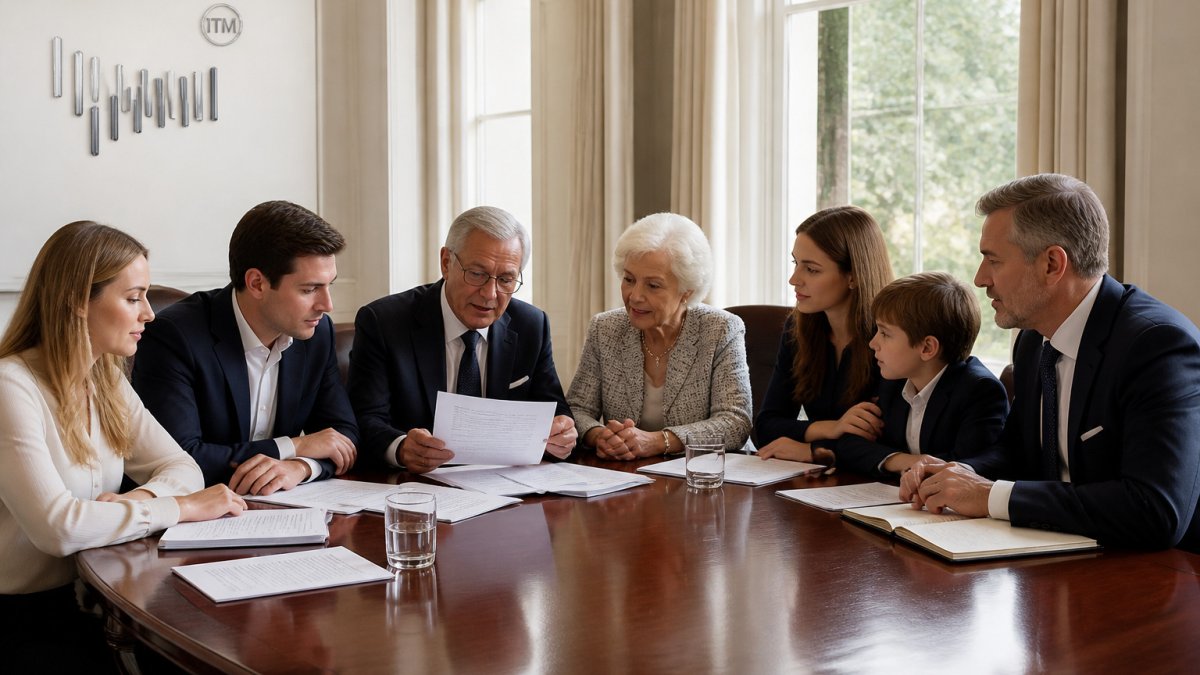
A workable template includes five parts: a statement of purpose, a description of governance bodies and their mandates, rules for family employment and board seats, an information and privacy protocol, and an amendment procedure. The amendment procedure matters most. A constitution that cannot change will eventually be ignored, while one that changes too easily offers no stability.
Any constitution should be reviewed by UK counsel against the relevant trust and succession rules before adoption, because the legal effect of such documents depends on how they are drafted and held.
Family Wealth Preservation Strategies Across Generations
Preservation means keeping real value intact after costs, taxes and inflation, not merely keeping the nominal capital figure stable. The strategies that tend to hold up across generations share a few features: diversified structures, documented investment objectives, and an explicit risk framework that every generation can read.
Institutional practice here draws heavily on forensic risk analysis and rigorous governance. That means stress-testing the portfolio against concentration, liquidity and key-person risk, and recording who is accountable for each exposure.
Capital structuring matters too. Capital structure of the underlying assets, whether operating businesses or property, shapes how much value survives each transfer. Our article on Efficient Capitalisation of Commercial and Industrial Projects goes deeper on the structuring side.
Next-Generation Wealth Transfer and Preparing Heirs
Heirs need preparation as much as the assets do. A common and effective approach is staged exposure: observing investment committee meetings, taking a bounded role in a single asset or project, and receiving formal governance training before taking decision rights.
Family Office Succession Plan Examples and What They Show
Real plans vary widely, but the strongest examples share a common sequence: an agreed constitution, a defined transition timetable, named successors for each governance role, and a review cycle. Where families have struggled, the failure usually lies in one of two places, either an informal understanding that was never written down or a plan that assumed a single successor for every role.
Note that the example above is illustrative. Each family's circumstances, jurisdictions and tax position differ, so no template should be adopted without tailored advice.
Booking a Succession Planning Review With Integer Wealth Global
If your family office is weighing these questions, the practical next step is a structured review of your current governance, succession readiness and risk exposures. A structured review is one way to assess where your plan stands today. Explore Investment Opportunities to see how the firm approaches structured capital, then arrange a conversation to discuss your specific position.
Frequently Asked Questions
What does succession planning mean for a family office?
Succession planning for a family office is the process of deciding who will lead the office, manage the family's assets and make investment and governance decisions as the current principals step back. It covers leadership handover, the transfer of ownership and control, and the preparation of successors. Because family offices often hold wealth across several generations, the plan also needs to address family relationships, shared values and how decisions will be made when no single principal holds all the authority. A written plan reduces the risk of disruption, disputes and value erosion during a transition.
How can a family office preserve wealth across generations?
Wealth preservation over several generations typically combines diversified investment governance, clear spending and distribution rules, and regular risk review covering market, legal, tax and cybersecurity exposures. Many families also set up structures that separate control from beneficial ownership and agree a family constitution that governs how assets are held and used. Preservation depends on disciplined governance as much as investment returns, and the principles should be reviewed with qualified legal and tax advisers, since rules vary by jurisdiction.
When should a family office start succession planning?
Succession planning is best started well before any transition is imminent, ideally while the current principal is still actively involved and able to mentor successors. Waiting until a health event or sudden departure forces decisions tends to produce weaker outcomes. Starting early gives time to identify and prepare the next generation, test governance arrangements and agree how decisions will be made. Reviewing the plan periodically, for example after major life events or changes in family membership, helps keep it current.
What should a family office succession plan include?
A practical succession plan usually covers leadership roles and selection criteria, the governance framework and decision-making rights, ownership and control arrangements, education and development for successors, and a communication plan for family members. It should also address how investment mandates will be maintained, how disputes will be resolved and what happens if a chosen successor is unable or unwilling to take on the role. Documenting these points in a family constitution and reviewing them with legal and tax advisers makes the plan easier to apply when it is needed.